

ICS at the EU–Western Balkans Media Literacy Conference in Belgrade
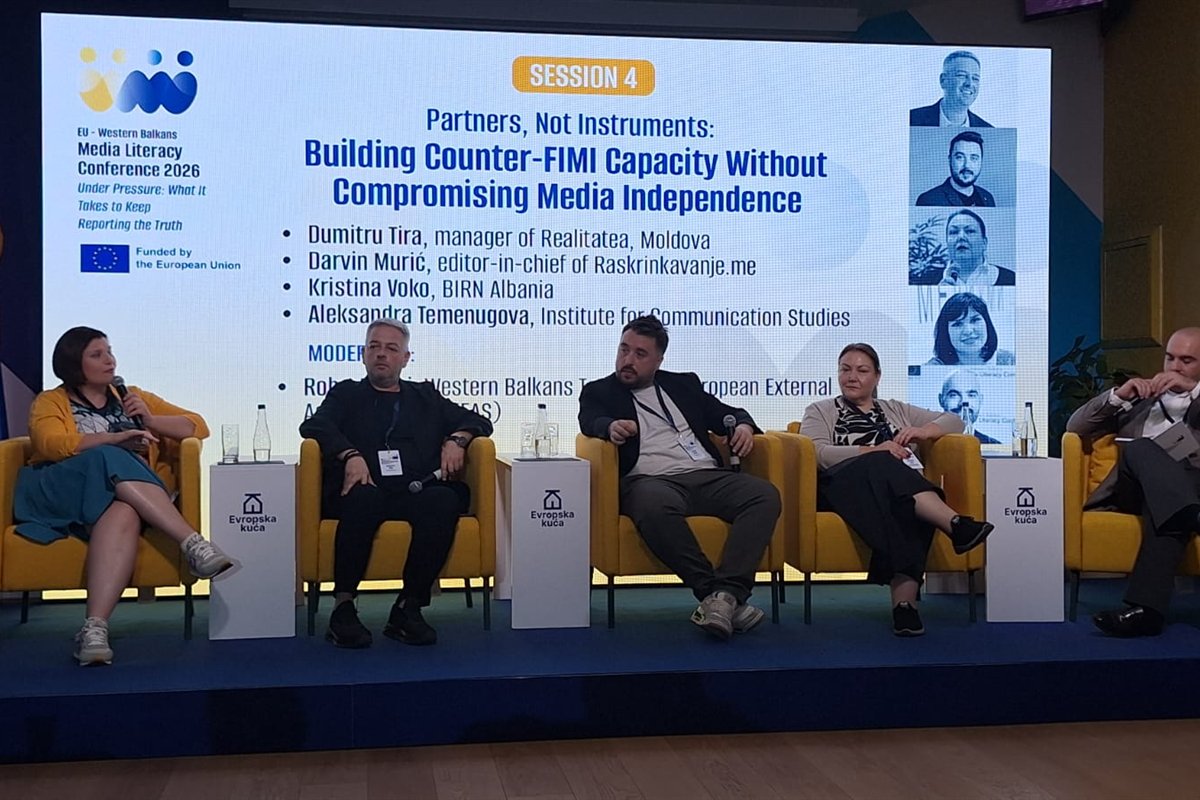
The Institute of Communication Studies (ICS) participated in the traditional EU–Western Balkans Media Literacy Conference 2026, held on 7 October at Europe House in Belgrade under the title “Under Pressure: What It Takes to Keep Reporting the Truth.” The conference focused on editorial independence, the influence of platforms and algorithms, artificial intelligence, disinformation, and Foreign Information Manipulation and Interference (FIMI).
ICS was represented by Aleksandra Temenugova, who participated in the panel “Partners, Not Instruments: Building Counter-FIMI Capacity Without Compromising Media Independence”, together with representatives from Moldova, Montenegro and Albania. The panel was moderated by Robert Huqi from the Western Balkans Task Force at the European External Action Service (EEAS).
During the discussion, Temenugova shared the experience ICS has gained so far in North Macedonia in building an institutional response to FIMI while at the same time safeguarding freedom of expression and media independence.
She stressed that addressing coordinated disinformation campaigns should not be reduced to assessing whether a particular piece of content is “true” or “false”, as even factually accurate information can be used manipulatively. The focus should instead be on patterns of behaviour, coordination, manipulation techniques, amplification methods and potential harmful impact, while legitimate public debate must remain protected.
Particular attention was devoted to the relationship between institutions and the media. More effective and timely channels for information exchange are needed, but they must have clearly defined boundaries.
“The channel between institutions and the media should serve for the timely exchange of information and evidence, not for editorial guidance. Partnership ends where cooperation begins to influence editorial decisions,” Temenugova stressed.
The panel also emphasised that a whole-of-society approach to building resilience does not mean that all actors should operate under government direction. Instead, institutions, media, researchers and civil society organisations should contribute in line with their respective mandates while preserving their independence.
The conference was opened by Andreas von Beckerath, Ambassador of the European Union to Serbia, who highlighted the importance of editorial independence and the role of the media in ensuring independent reporting and democratic public debate.