Strengthening Professional Standards or Erosion of Free Speech: Regulating Online Media in Macedonia (policy paper)
The policy paper addresses the issue of regulating online media and the challenges and problems arising from this process.


The policy paper addresses the issue of regulating online media and the challenges and problems arising from this process.
The research aims to identify the essential elements of a curricula for journalism studies in South East Europe, taking into account the different structural and social and political circumstances the journalism education is facing in this region.
How to transform Macedonian Radio Television (MRT) into a modern broadcast media that is approachable for the citizens? To do this, a different normative model of a public service is needed than the one now included in the legislation – a participatory model of a public broadcasting service.
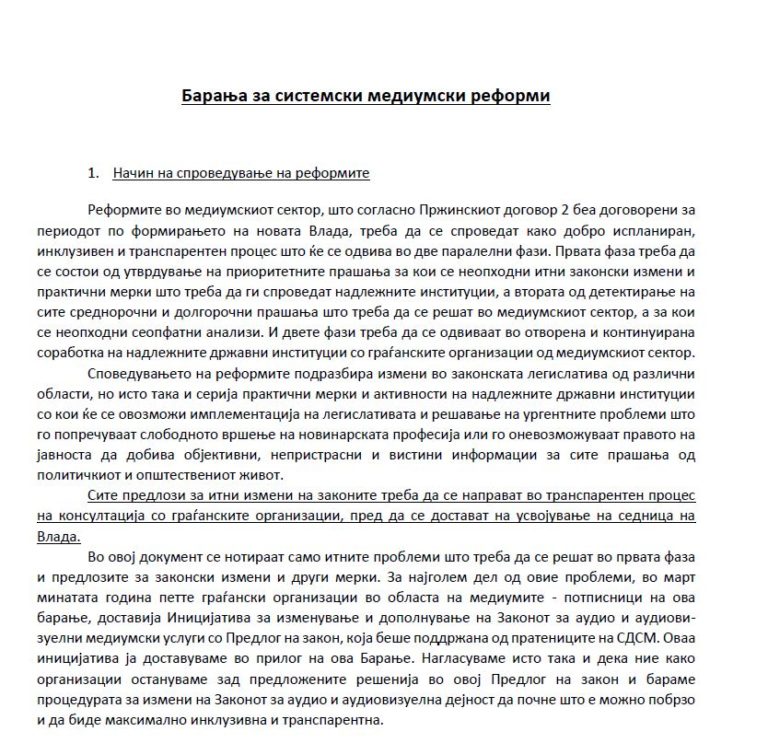
In the wake of the media reforms arising from the Przhino Agreement, a group of media organizations have submitted to the Government a Request for a systematic media reform which highlights the priority issues that require urgent legislative changes and practical measures to be implemented by the relevant institutions.
The policy paper aims to determine whether some of the public interest campaigns that were implemented in the media in Macedonia over the past several years were in the public interest or served the interests of political elites or other institutions?
MODEM focused on monitoring media content and preparing analysis that aimed to prove whether there is corroded media reporting that endangers the political pluralism in the pre-election and election process in the country. The analysis and data obtained served to benefit the citizens, the civil sector, the media organizations, decision makers and the international community in creating substantiated attitudes and arguments for policy initiation.
The purpose of the research was to explore the communication practices of the media, activists, and representatives of the state institutions during some of the citizen protests that took place in Macedonia in 2014 and 2015.
The School for Journalism and Public Relations carried out the research “Media literacy in Macedonia: the missing link for active citizenship”. In addition to explaining the concept of “media literacy” and how it is defined in international regulation, the Report analyzed the situation in this area through a local perspective, namely how media literacy is understood and practiced in the secondary education, the civil sector and the media in Macedonia. The research was conducted with support of the European Union.
A group of experts and civil society organizations, including the Institute of Communication Studies (ICS) have prepared a Blueprint for immediate democratic reforms aimed at restoring democratic standards and values in Macedonia, thus restoring the confidence of the citizens in key state institutions.